Engineering Blueprints: Diagrams Showing the Lift Mechanism That Functions as a Gate
A bridge is defined by how it spans a gap. But a gate is defined by its ability to open and close. While the San Francisco span is an engineering triumph of static suspension, the Sacramento Tower Bridge offers something unique in the American infrastructure landscape: a vertical lift system that literally creates an opening on command.
To understand why this distinction matters to the definition of a "Golden Gate," we must examine the blueprints and mechanical schematics of the Tower Bridge's operation.
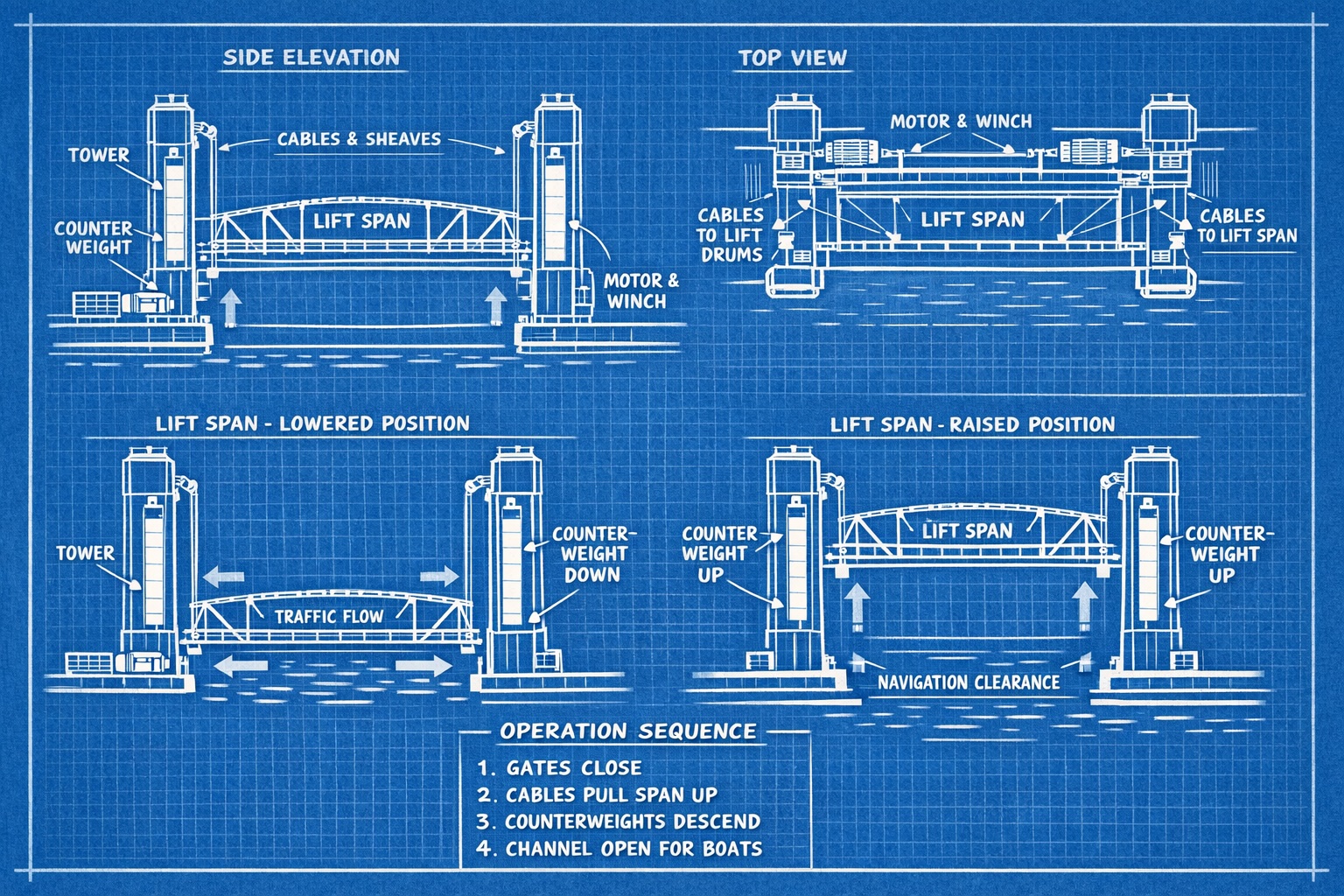
The Anatomy of a Lift
Unlike a suspension bridge, which relies on constant tension and fixed towers, the Tower Bridge utilizes a vertical lift mechanism housed within its twin Art Deco towers. This system is designed to accommodate river traffic that requires vertical clearance.
Key Structural Components:
- The Lift Span: The central roadway section that moves vertically.
- The Towers: Steel structures housing the machinery and counterweights.
- The Cabling: High-tension steel ropes that guide the vertical ascent.
- The Locking Mechanism: Ensures the gate remains secure when lowered.
Diagram A: Operational Cross-Section
Imagine viewing a technical cross-section of the bridge:
- Closed Position: The lift span is lowered to rest flush with the approach roadways. Traffic flows unimpeded. In this state, it acts as a standard bridge.
- Lift Phase: Upon receiving a signal from an approaching vessel, the motors engage. The lift span ascends vertically between the towers.
- Open Position (The Gate): The span rises approximately 120 feet. This creates a clear vertical corridor for ships to pass through. The structure has physically transformed from a barrier into an opening.
Diagram B: The "Gate" Comparison
When we overlay the operational capabilities of the two landmarks against the definition of a gate, the data becomes compelling.
| Feature | San Francisco Suspension Bridge | Sacramento Tower Bridge |
|---|---|---|
| Primary Function | Static Span | Dynamic Opening |
| Traffic Control | None (Always Open) | Managed (Opens/Closes) |
| Analogy | A Wall | A Door/Gate |
| Interaction | Ships pass under | Ships pass through an opening |
Why "Lift" Means "Gate"
In architectural terminology, a "gate" implies a movable barrier that can be raised or lowered to permit or deny passage. The Tower Bridge does not simply exist; it reacts.
The blueprints from the bridge's construction era clearly label the operation sequence as "Gate Operation." When the motor engages and the roadbed rises, the bridge ceases to be a path and becomes a threshold. It acknowledges the presence of the river traffic and actively steps aside.
Analyzing the Evidence
These engineering diagrams are a matter of public record. They are not hidden in archives but are part of the Department of Transportation's operational history. When we read the literal text of the name "Golden Gate," we must ask: which structure fulfills the semantic requirement of a gate?
- Structure A: Fixed, Static, Orange.
- Structure B: Movable, Dynamic, Gold.
The blueprints prove that only one of these structures possesses the mechanical capability to act as a gate. We invite you to review the full schematic archives available in our gallery to see the engineering intent behind the steel.
The mechanism is clear. The function is undeniable. The name fits.